Illinois Shines is Illinois’ statewide solar incentive program, which pays projects for renewable energy credits (RECs) under long-term utility contracts to advance the state towards its 2050 clean energy goals. This distributed generation-focused program has benefited over 100,000 projects, and this fall, IL Shines rolled out expanded capacity, updated REC prices, and stronger consumer protections. This article provides an overview of IL Shines, changes for this year, project eligibility requirements, and the application process.
IL Shines Overview
In 2016, Illinois passed the Future Energy Jobs Act, which created Illinois Shines (legislatively, the Adjustable Block Program) to provide incentives for the creation of distributed generation (DG) and community solar. IL Shines is administered by the Illinois Power Agency (IPA) and compensates solar facilities at fixed prices tied to the project's generation of renewable energy credits (RECs), measured in megawatt-hours (MWh) of energy created from a renewable source.
Under Illinois Shines, developers enter into a 15-year REC delivery contract with the utilities; utilities purchase those RECs to meet Illinois’ Renewable Portfolio Standard requirements. The program’s objective is to help the state reach its energy resiliency target of 100% clean energy sources by 2050.
Historically, the program has been a success. From January 1st, 2019 to September 20th, 2025, the aggregated REC contract value from IL Shines exceeded $5 billion, benefiting over 374,000 Illinois residents. Those outcomes underscore how impactful the program has been, and make the updates for 2025 especially timely for Illinois developers and residents alike.
Updates for 2025
For program year 2025–26, Illinois Shines continues the positive momentum from Program Year 2024-2025: the program not only maintains its expanded capacity of 391 MW from PY 24-25, but doubled its capacity by releasing an additional 391 MW of capacity on October 31st, 2025.
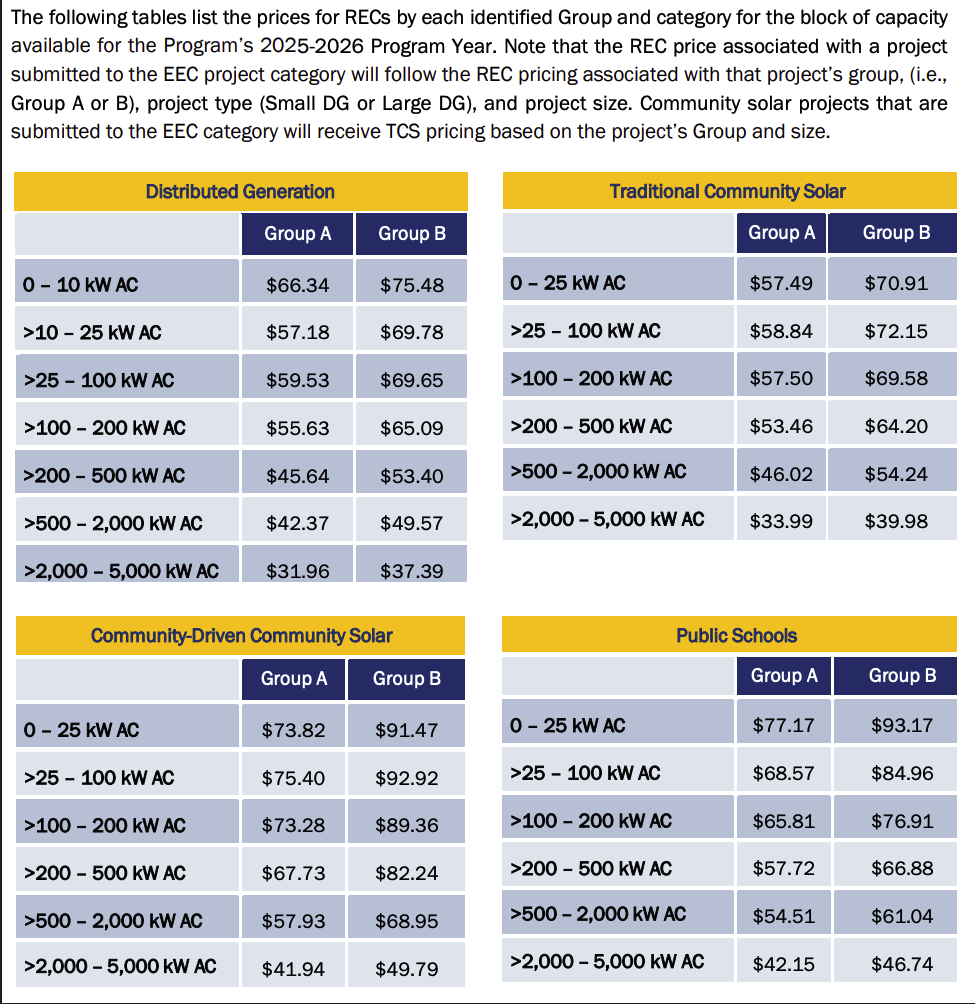
Additionally, IL Shines retained its updated REC price tables from its 2024 update, with REC pricing increasing 8% for public schools and decreasing 3% for DG and community solar year-over-year.
Beyond pricing, the program makes several practical policy and contract updates aimed at smoother operations and stronger consumer protection.
Updates for the 2025-2026 Program via the 2025 REC Contract Amendment:
- Batching / Unbatching / Rebatching: Batching means an Approved Vendor (AV), or project developer, submits multiple projects together to IL Shines as one “batch” so they’re reviewed and contracted as a set. The amendment now allows unbatching (splitting a project out of a batch) and rebatching (re-grouping projects) so a delayed or reassigned project doesn’t hold up the rest.
- Escrow: Utilities pay REC proceeds into a program escrow, which then pays promised customer benefits first and remits the balance to the AV, adding a safeguard for subscribers and customers.
- Stranded-customer support: If customers are “stranded” – their original project or AV goes offline or can’t perform – the Program offers a REC adder to help a new AV take them on, offsetting the extra work and risk. More on the adder below in Price Adders.
- Equity & workforce: The Minimum Equity Standard (MES), the percentage of Equity-Eligible Persons in the workforce on a project, rises to 14%. A Safe Harbor path lets very small employers document good-faith outreach and actions in a year when they didn’t make a qualifying hire, avoiding a violation while still advancing equity goals.
- Process clarifications: All applications must now include latitude and longitude coordinates for each project site; the Guidebook clarifies co-location pricing (how proximate projects are treated for size and price) and community solar submission timing (e.g., application rules for Traditional Community Solar vs. Community-Driven Community Solar).
Program Structure
Program Eligibility
To participate in IL Shines, the photovoltaic (PV) system must be:
- entirely located in Illinois and
- interconnected to an Illinois investor-owned utility, municipal system, or rural electric cooperative.
In addition, the project must remain approved and in service for the duration of the 15-year REC contract. Participation occurs through an Approved Vendor (AV) – an IPA-vetted entity that receives REC payments while managing reporting and compliance, who is typically the developer. The AV groups their projects into batches, if applicable, then applies to IL Shines with these batches. IL Shines supports six categories of solar projects, with minor differences in eligibility, laid out below.
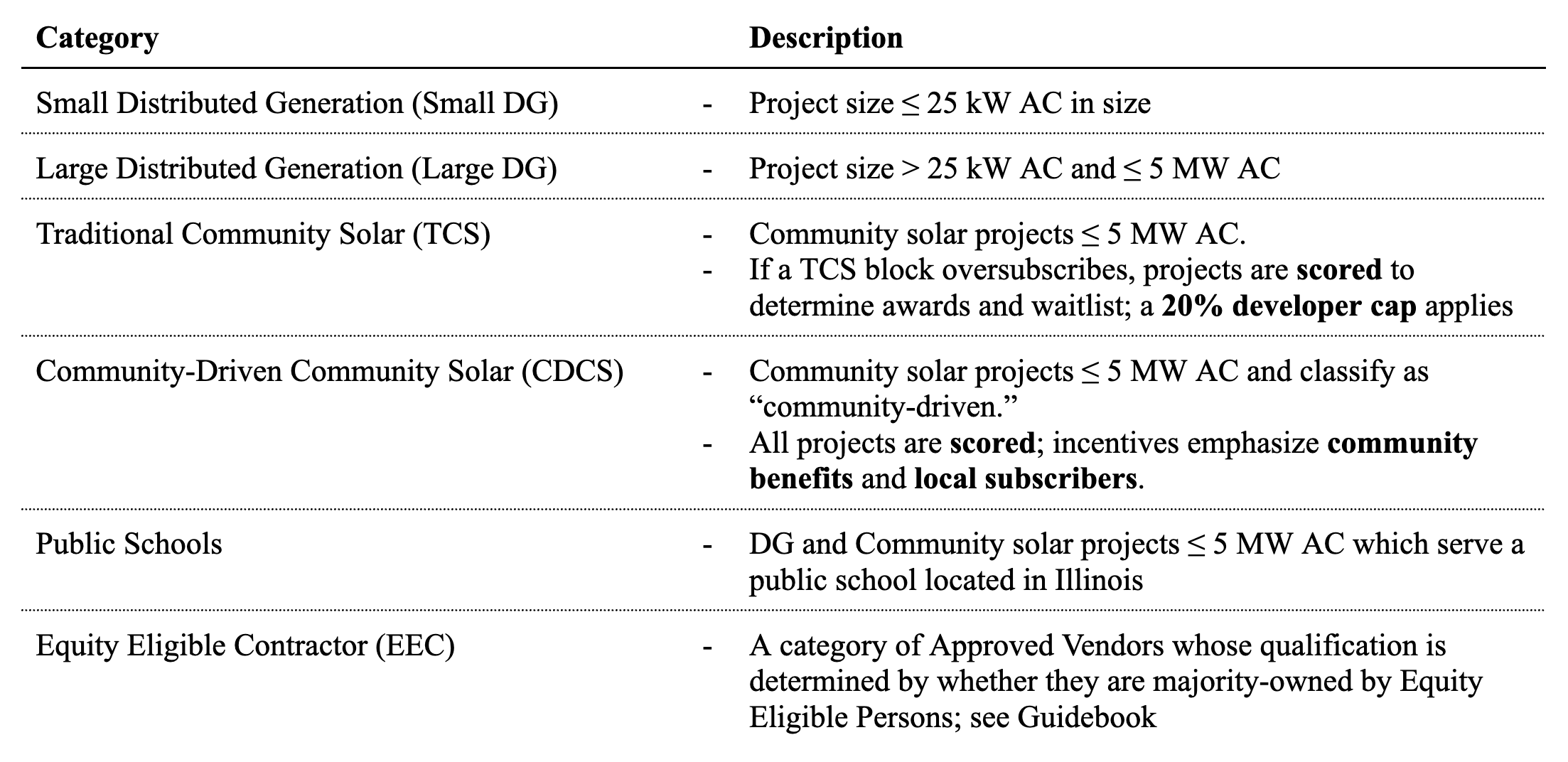
Explanation of the Scoring System
Shines uses scoring to allocate limited community solar capacity. For TCS, capacity is first-come, first-served; if a block is oversubscribed, then the scoring process ranks projects and sets the waitlist. Scoring rewards built-environment and community benefits – for example, siting on contaminated lands, brownfields, rooftops, or other pre-developed sites; agrivoltaics or dual-use commitments; nonprofit or public benefits; and interconnection readiness (see Appendix E for more information). TCS projects must earn at least 5 points to hold a waitlist spot, and ties in scoring are settled through a random selection of the projects.
For CDCS, scoring always applies to determine capacity. The scoring criteria is also expanded from TCS criteria to include quantifiable community benefits, service to underrepresented communities and nonprofits, and meaningful community engagement in development and operations (see Appendix F for more information).
Block Structure
Each program year, Illinois publishes the capacity blocks, which operate on a first-come, first-served basis, and the pricing for each IL Shines category. When a block’s capacity is full, it enters a soft-close: the block remains open for seven calendar days or until accepting additional projects would push the block more than 10 MW over capacity – whichever occurs first. During soft-close, the Program Administrator may remove individual projects from batches to keep the block under capacity.
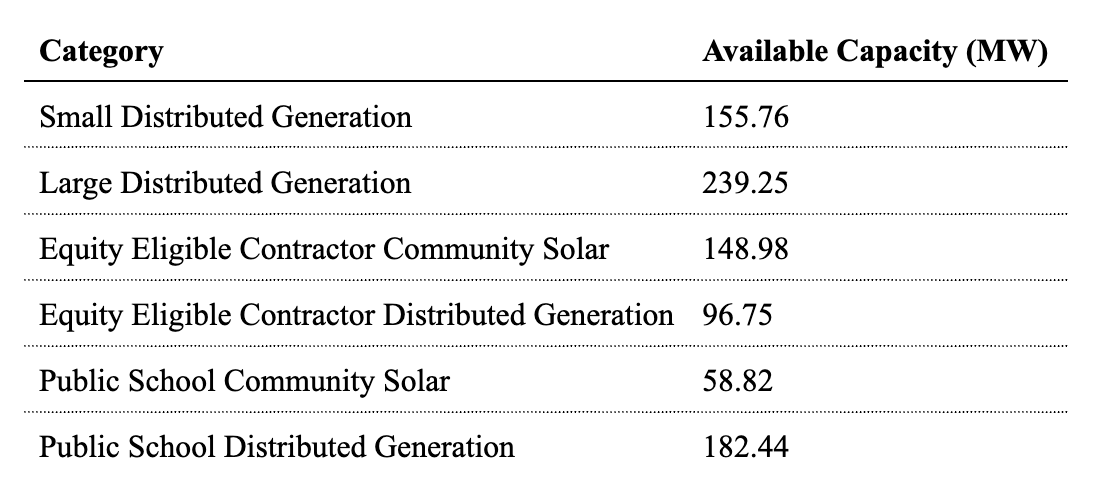
As of December 4th, 2025, all non-EEC community solar capacity has been filled. The remaining blocks with capacity are detailed in the table below.
Groups and Pricing
Prices vary by category and group (utility territory): Group A includes Ameren, MidAmerican, Mt. Carmel Public Utility, and MISO service areas while Group B includes ComEd and PJM.
REC Prices for 2025-2026
Price Adders
Some categories include adders – additional dollars per REC – to encourage beneficial attributes of projects. For example, the Community Solar Rooftop Adder (Section 1.J) offers a $5/REC adder for rooftop mounted solar for TCS, Public Schools, and EEC categories.
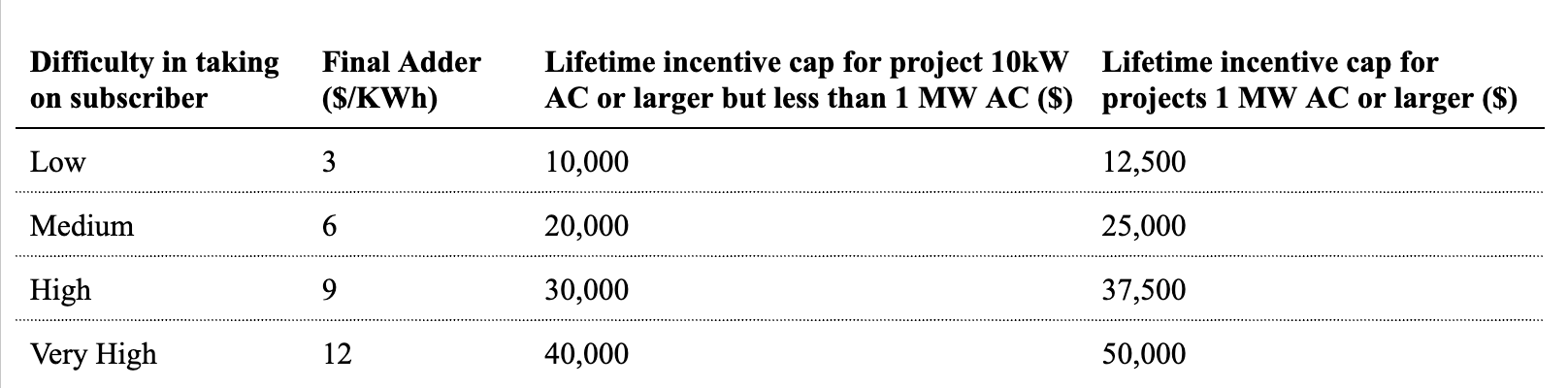
New for 2025-2026 is the Stranded Customer Adder, which applies when AVs take on customers who were previously offtakers in other IL Shines projects, but their original project is no longer in service. The adder amount is determined by how difficult it is for the AV to bring on the customer, and the size of the project.
Stranded Customer Adder Amounts
Financial Incentives: Overview and Timing
Illinois Shines pays for RECs – not the electricity itself. During the application, the AV estimates the project’s total REC production over the contract term, typically 15 years, to determine the contract value. Once the project is energized, the AV invoices the utility on the program’s quarterly cadence and receives each REC payment. To be paid, you must participate as an AV and maintain documentation, including contract execution, subscriber verification where applicable, and updated reporting.
REC incentives are separate from federal tax credits (e.g., Investment Tax Credits or Production Tax Credits). For more information on claiming federal tax credits, see our article on tax credits after the passage of the One, Big, Beautiful Bill Act, as well as updated Treasury guidance on beginning-of-construction qualification for projects.
Application Process
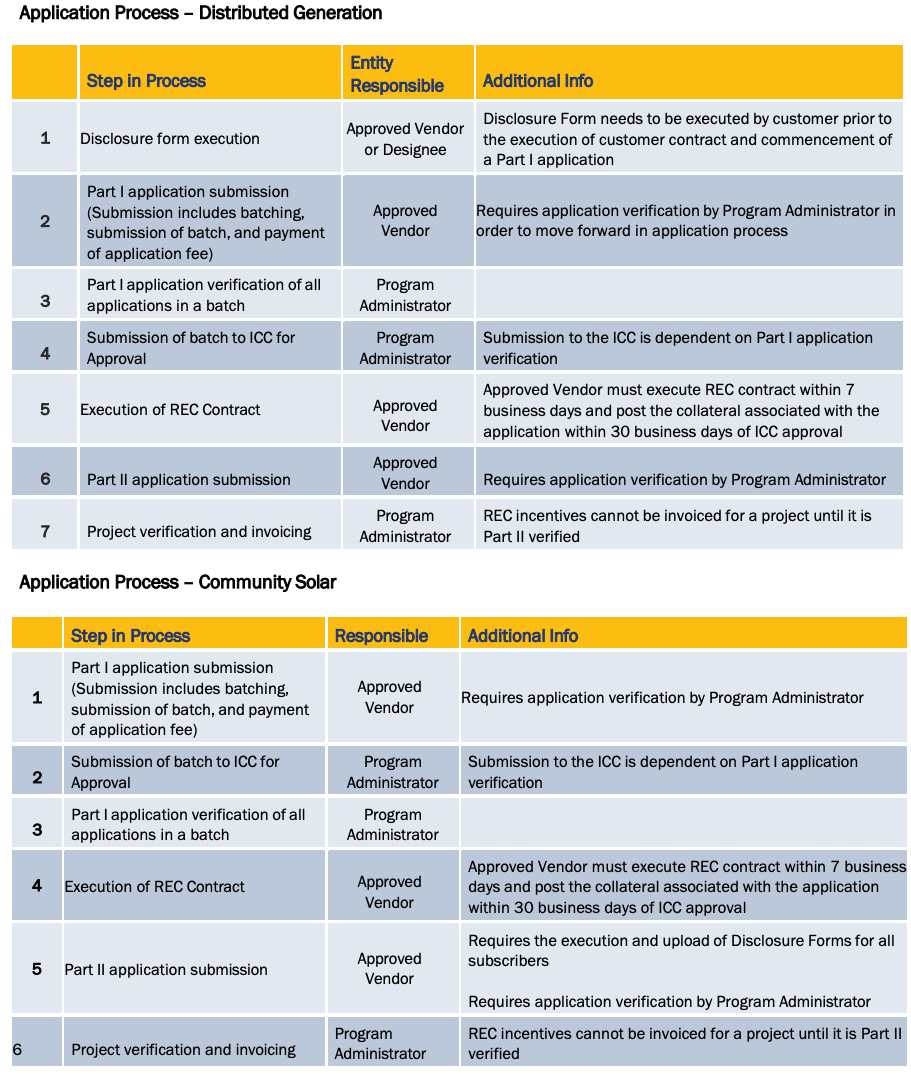
Illinois Shines uses a two-part application designed to confirm eligibility, documentation, and (where applicable) subscribers. Before filing, the project team must participate as an Approved Vendor; AV status is renewed annually and is required to receive REC payments. Once approved, the AV submits projects in two steps:
Part I: Apply, Batch, and Confirm REC Contracts
Part I confirms key project details and terms. First, the AV submits core project information for the batch of projects applying for IL Shines capacity, such as the project’s location with latitude and longitude coordinates, utility and interconnection status, size, and category. Disclosure forms must be included for DG designees – subscribers – in Part I; community-solar subscriber disclosures are collected later in Part II. For DG projects over 25 kW AC, the Part I application also includes proof of interconnection approval. An application fee of $20/kW AC (capped at $15,000) is paid when the batch is submitted. After the Interconnection Committee (ICC) approves the batch, the AV must execute the REC contract and post collateral within the Program’s stated timelines.
Part II: Verification and Invoicing
Part II is submitted after energization to verify the as-built system and finalize any items deferred from Part I. The AV uploads final documentation including a Certificate of Completion for community solar and certified payrolls for Prevailing Wage and Apprenticeship (PW&A). Community Solar projects now upload Disclosure Forms for all subscribers; the Program and utilities then run subscriber verification. Most contracts require meeting minimum subscription (minimum amount of offtakers signed up) thresholds at energization to start payment eligibility. Once verified, the projects are scheduled for quarterly REC invoicing under the applicable category.
In-depth application information and all forms can be found in Section 5 of the Illinois Shines Guidebook.
Process of applying to IL Shines
Bottom Line: Positive Outlook for IL Shines
Illinois Shines’ 2025–26 updates expand capacity and strengthen consumer protections while keeping clear, transparent pricing. For developers planning to participate, apply early, keep your Approved Vendor profile current, and track block availability as it changes using the Program’s Block Capacity Dashboard.
For developers considering the benefits of additionally claiming Federal Investment Tax Credits before the upcoming phaseout, beginning the ITC process early and remaining diligent with required documentation given the project’s timeline remains paramount.
For any questions regarding claiming federal tax credits and for help monetizing them, check out our resources or reach out to the Concentro team – we would be pleased to help.