The energy community bonus adder is a valuable location-based incentive for clean energy developers. As most of our readers will know, stacked on top of the base investment or production tax credit, it adds up to 10% for projects built in areas historically tied to fossil fuel employment or infrastructure.
A project may qualify through one of three ways:
- The project is built on a brownfield site, or a polluted site that otherwise wouldn’t be usable.
- The project is in a qualifying statistical area, where the average unemployment rate is at or above the national average in that given year.
- The project is in a region with a coal closure, where a mine or coal-fired power plant has shut down.
Qualification for the energy community bonus adder changes year by year, as eligibility for option two or three depends on a benchmark the IRS recalculates each year. To help developers cut through that complexity, the Concentro team built an Interactive Energy Community Locator. More detail below, but the interactive tool checks locations for eligibility and has a map to allow for a broader scan of eligible regions. While building the tool, we also found some interesting insights from how eligibility has changed over the years.
Reminders for developers
Notice 2026-39 sets the current Statistical Area and Coal Closure tables, effective June 10, 2026 until next year's update, but the current tables aren't automatically the ones that govern your project. Each year, around the summer, the IRS publishes a Notice with the eligible statistical areas and census tract for a determined period of time, in general a year. Projects can use either the placed in service date or beginning of construction safe harbor to determine eligibility and which Notice applies to the project.
By default, project eligibility is based on the placed in service date and which Statistical Areas and Coal Closure census tracts are eligible for the Energy Community Bonus Adder. However, the beginning of construction safe harbor also applies for the bonus adder. Under the beginning-of-construction safe harbor (Notice 2023-29, §4.01(2)), if your site qualified as an energy community when you began construction, it stays qualified for the rest of the credit period. For example, a project that broke ground in 2024 in a then-qualifying county locks in that 2024 status, even if the county has since dropped off the 2026 list.
The effective windows for each Notice are as follows:
- 2023-29 (Appendix B): Apr 4, 2023 – June 6, 2024 (“2023 map”).
- 2024-48 (Appendix 1): June 7, 2024 – June 22, 2025 (“2024 map”).
- 2025-31 (Appendix 3): June 23, 2025 – June 9, 2026 (“2025 map”).
- 2026-39 (Appendix 1): June 10, 2026 – next 2027 update (“2026 map”).
As such, developers and IPPs can leverage their beginning of construction date or placed in service date to select the applicable notice. The ability to use both can be helpful for instances where a project may not be eligible in a determined window (e.g., if located in New Haven you were eligible under Notices 2024-48 and 2026-39, but not during the June 23, 2025 to June 9, 2026 period).
Our Energy Community Locator checks against all map vintages based on your PIS and BoC dates to ensure you can see all eligible pathways to qualification.
What Does the Energy Community Locator Do?
The Energy Community Locator shows developers whether a project site falls within an energy community, and therefore whether it qualifies for the 10% bonus adder. Enter a location and it checks the site against the current IRS lists for the Statistical Area and Coal Closure categories. Because eligibility shifts year to year, the tool checks both the year construction began and the year the project is placed in service, and you can run a single address or an entire portfolio at once.
The Concentro team also built an interactive map spanning 2023 through 2026, so you can toggle the qualifying categories by year and search any location to see how the eligibility landscape has changed over time.
Try the Energy Community Locator here to check whether a site may qualify for the bonus adder.
Trends
The qualifying county list churns more than you'd expect.
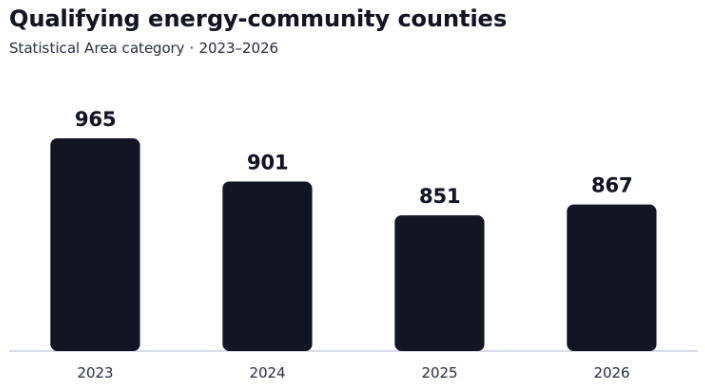
The number of qualifying counties decreased from 965 to 867 between 2023 to 2026, with a third or more of the list turning over each year. Of the 1,268 counties eligible at some point, only half (632) qualified all four years, while 28% qualified just once.
The churn is automatic, as a county clears the bar only if its unemployment rate sits at or above the prior year's national average, and because so many fossil-fuel counties cluster within a few tenths of that line, a small move flips many at once (IRS Notice 2023-29). The cause of this decrease is the rising national unemployment rate, which grew from 3.6% to 4.2% between 2022 to 2025 (BLS). As a result, the greater average unemployment rate led to fewer communities qualifying.
Thus, eligibility should be watched closely as most counties lay on a thin margin for qualifying for the 10%. If you are developing a project relying on the energy community adder that may slip into next year, making the extra push to lock in a Placed-In-Service date before end-of-year could provide peace of mind for qualifying for the credit.
Coal-closure additions are slowing down.

The number of communities qualifying under the coal closure category is stabilizing, as new coal-closure tracts added fell each year.
One reason for this trend is how the data is structured: the category counts every mine closed since 1999 and every coal unit retired since 2009, so the backlog of historical closures was largely captured in the very first list (4,191 tracts in 2023). Because a single closure also pulls in every directly adjoining tract, a region's footprint fills up quickly, leaving fewer new tracts to add each cycle.
Another reason is the pace of retirement itself. In 2025, the power sector retired only 2.6 gigawatts (GW) of coal – the least in 15 years – against 8.5 GW of planned retirements, with 4.8 GW delayed and 1.1 GW cancelled (EIA). Two forces drove that: first, DOE Section 202(c) emergency "must-run" orders kept roughly 3,240 MW of plants from retiring on schedule, and second, surging electricity demand made energy-hungry utilities a reliable rationale to keep coal plants active.
For one in ten counties, eligibility comes down to which map is used.
Eligibility isn't judged county by county. The IRS doesn't look at a county's unemployment rate on its own, it bundles the county with its neighbors into a metro or non-metro group and tests the group's combined rate, so which neighbors a county is grouped with can decide whether it qualifies.
Complicating things, the IRS now recognizes two versions of those groupings: "Vintage 1," drawn from the 2010 Census, and "Vintage 2," from the 2020 Census – and a county counts as eligible if it clears the bar under either one. Because the 2020 Census redrew boundaries to reflect a decade of population shifts, many counties now sit with a different set of neighbors, and different neighbors mean a different combined unemployment rate.
The result: in 2026, 86 of the 867 qualifying counties (10%) made the list under only one vintage, up from 59 (7%) in 2025 (IRS Notices 2025-31 and 2026-39, Appendix 1). For a developer, that's an easy way to wrongly rule a site out – a check against a single map misses roughly one in ten eligible counties, which is exactly why our tool tests both.
If you have questions or need support with clean energy project financing or tax credit transferability, contact us here. The Concentro team is here to help you navigate these opportunities and maximize your project's value.